Quantum Entanglement, the Subconscious and the Energy You Carry
A calm look at quantum entanglement as a metaphor for how thoughts, emotions and the subconscious may shape the life we experience.
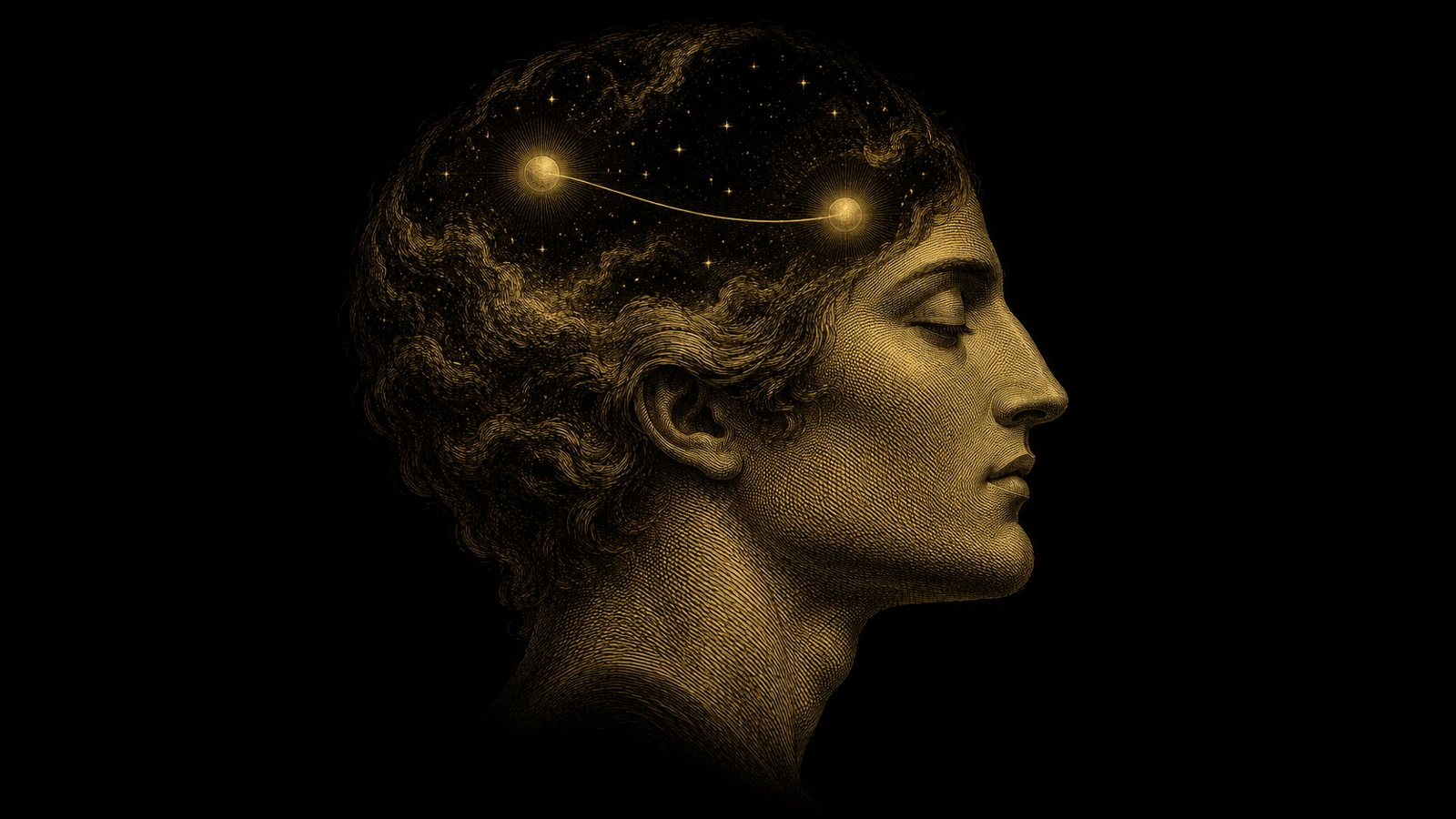
There is an old intuition, found in many spiritual traditions, that nothing in the universe is truly separate. Science has begun to echo a small part of it in a way that still surprises people. I want to walk through that idea with you slowly, and ask what it might mean for the way you think, feel and live.
I should say plainly where the firm ground ends. What physics has shown is real and remarkable. What I will say about the mind and your destiny is a way of seeing, a reflection offered by many thinkers and teachers, and not a proven law. Hold it gently, and keep whatever rings true for you.
Two particles, one connection
Imagine two identical dice. One is rolled in your hand, and the other thousands of miles away, and somehow the result of one always answers the other. That is not magic. It is a picture of what physicists call quantum entanglement.
The story begins in 1935, when Albert Einstein, Boris Podolsky and Nathan Rosen proposed a thought experiment now known as the EPR paradox. If entanglement were real, they argued, two particles could stay linked even when separated by light years. Decades later, in 1982, the physicist Alain Aspect carried out experiments showing that this link does exist. Change the state of one particle, and its partner changes at once, with no signal travelling between them.
Earlier in the century, the double-slit experiment had already hinted at something strange: light behaves differently depending on whether it is being observed. Together, these discoveries suggest that reality is less like a pile of separate objects and more like a web.
Now comes the question that the teachers of this idea ask. If everything is made of the same fundamental particles, is it so unthinkable that your mind, your thoughts and your energy belong to the same web? Science has not shown that they do. But it is a beautiful question, and it has been asked for a very long time.
The heart, the brain and the invisible field
Some researchers have pointed to the human heart. The HeartMath Institute reports that the heart produces an electromagnetic field reaching several metres beyond the body, and that this field may carry something of our emotional state into the space around us. Other voices go further. The physicist Roger Penrose and the anesthesiologist Stuart Hameroff have proposed that consciousness might be linked to quantum behaviour inside the microtubules of brain cells. These are open and debated ideas, not settled facts.
If they point in the right direction, though, your thoughts would not be sealed inside your skull. They would be more like signals, and the subconscious would be the antenna that sends and receives them. That is the image often used: a quiet radio, always tuned to something, whether you chose the station or not.
You may have felt this yourself. On a heavy day, everything seems to go wrong. On a light one, opportunities appear. Perhaps you thought about someone intensely and shortly afterwards they called. It is natural to wonder whether these moments are only coincidence, or a hint of a deeper connection. I do not think anyone can answer that for you with certainty.
What was written in you when you were small
The biologist Bruce Lipton has said that about ninety-five percent of our daily actions are driven by the subconscious, and that it is shaped mostly in the first seven years of life. During those years, he explains, the brain works mostly in slow theta waves, a very receptive state close to a gentle trance. Children absorb the world without questioning it.
So if you grew up hearing that money is hard to earn, that you cannot have everything, or that you must struggle for anything worth having, those sentences may still be running quietly in the background. You may no longer believe them with your reason. Your deeper mind may still treat them as true.
This is how many people explain the patterns that seem to follow us. Someone earns money and it slips away. Someone keeps attracting partners who confirm that love is difficult. Someone gets close to a goal, and an obstacle appears just in time. The conscious mind wants to walk in one direction, while an older program walks in another.
It is not a matter of blame. It is simply a reason to be curious about what you inherited.
Reprogramming, gently
If the subconscious was written, the traditions say, it can be rewritten. The neuroscientist Joe Dispenza describes a loop in which a thought triggers a chemical reaction, the reaction produces an emotion, and the emotion strengthens the thought. Fear breeds more fear. Gratitude breeds more gratitude. In this view, the first step is to step into the loop at a kinder point.
Several practices are commonly offered:
- Meditation and visualization. In quiet, the brain slows into deeper rhythms, and the subconscious becomes easier to reach. Picturing what you hope for as though it were already present helps the mind rehearse it.
- Feeling, not only thinking. Repeating a sentence such as "I am worthy of abundance" matters less than whether you can feel the warmth behind it. If every thought of money brings anxiety, the feeling is speaking louder than the sentence.
- Working with old wounds. Techniques like EFT and NLP are often suggested to loosen beliefs that were formed by past experiences.
- Acting in line with the change. If you want abundance but behave only out of fear of losing, your actions confirm the old story. Small choices that match the person you wish to become give your mind evidence.
None of this is a shortcut. If changing a life were as easy as changing a thought, we would all have done it by now. It takes repetition, and patience with yourself.
The test of faith and doubt
Those who write about this often describe a stage that surprises people. Soon after you begin to change, something happens that seems to contradict it: an unexpected expense, an old argument returning, a harsh criticism. The teaching says this is the moment the universe asks for confirmation. The question is whether your new way of being holds, or whether you fall back into the old frequency.
You do not need to believe the universe is literally testing you to see the wisdom in this. Any real change meets resistance. A person who wants a healthier relationship will see the old patterns return and have to choose differently. A person who wants more confidence will meet criticism and discover whether their sense of worth still depends on others' approval. Seen this way, difficulty is not proof of failure. It may be a sign that something is being adjusted.
Many people who walk this path also report that they become calmer. Problems do not vanish, but they stop feeling like punishments. They begin to look like part of a longer lesson. Some friendships drift away and new ones arrive. Coincidences seem to gather, and a quiet trust grows.
Old words for the same web
Long before physics, other cultures spoke of an invisible field joining all things: prana in the Hindu tradition, chi in Chinese thought, the Akashic field in Western esotericism. The physicist David Bohm imagined a holographic universe, in which what we perceive is the surface of a larger, interconnected order. Erwin Schrödinger is quoted as saying that the mind and the world are one.
Some people find in these ideas a way to understand experiences that are hard to explain: déjà vu, premonitions, the feeling of having known someone before meeting them, twins who sense each other's pain, or the idea of soulmates as two consciousnesses that remain in resonance. It is important to remember that these are interpretations. Entanglement is a real physical phenomenon between particles. That it explains the bond between two people is a poetic extension, and an honest speaker will say so.
Letting go of control
The last piece, and the one I find most human, is surrender. You can hope for something with anxiety, and in doing so keep reminding yourself that you do not have it yet. Or you can hope for it with trust, and let go of the need to control how and when it arrives.
Four simple attitudes are offered for this: faith before evidence, gratitude before the thing arrives, detachment from the outcome, and acting as the person you are becoming. The invitation is not to pretend that everything is fine. It is to loosen your grip on fear, and to see whether life feels different from there.
A quiet closing
Whether or not the universe is a web of entangled minds, one thing is hard to deny: the stories we carry inside shape how we meet each day. Perhaps the most useful thing you can do tonight is to ask yourself what you really feel when you think about what you want. If there is fear, listen to it kindly. If there is gratitude, let it grow. The power people search for outside themselves has probably been waiting in you all along, patient and unhurried, until you were ready to look.

How to Remember Your Soul Contract and Your Life's Mission
Signs, patterns, gifts and quiet practices that many spiritual traditions say can help you rediscover the purpose your soul chose before birth.
Read →
Edgar Cayce's Prophecy About Dogs and the Awakening of Our Companions
A reflective look at a prophecy attributed to Edgar Cayce about dogs as spiritual companions, and the stories people tell of their pets.
Read →
What Your Soul May Experience While You Sleep
A gentle look at what spiritual traditions say happens to the soul during sleep: the three planes, the silver cord, lucid dreams and simple nightly protection.
Read →