What Happens to a Dog's Soul in the First Days After Death
A comforting reflection, framed through Edgar Cayce's teachings, on what a dog may experience after death and how the bond with its person continues.
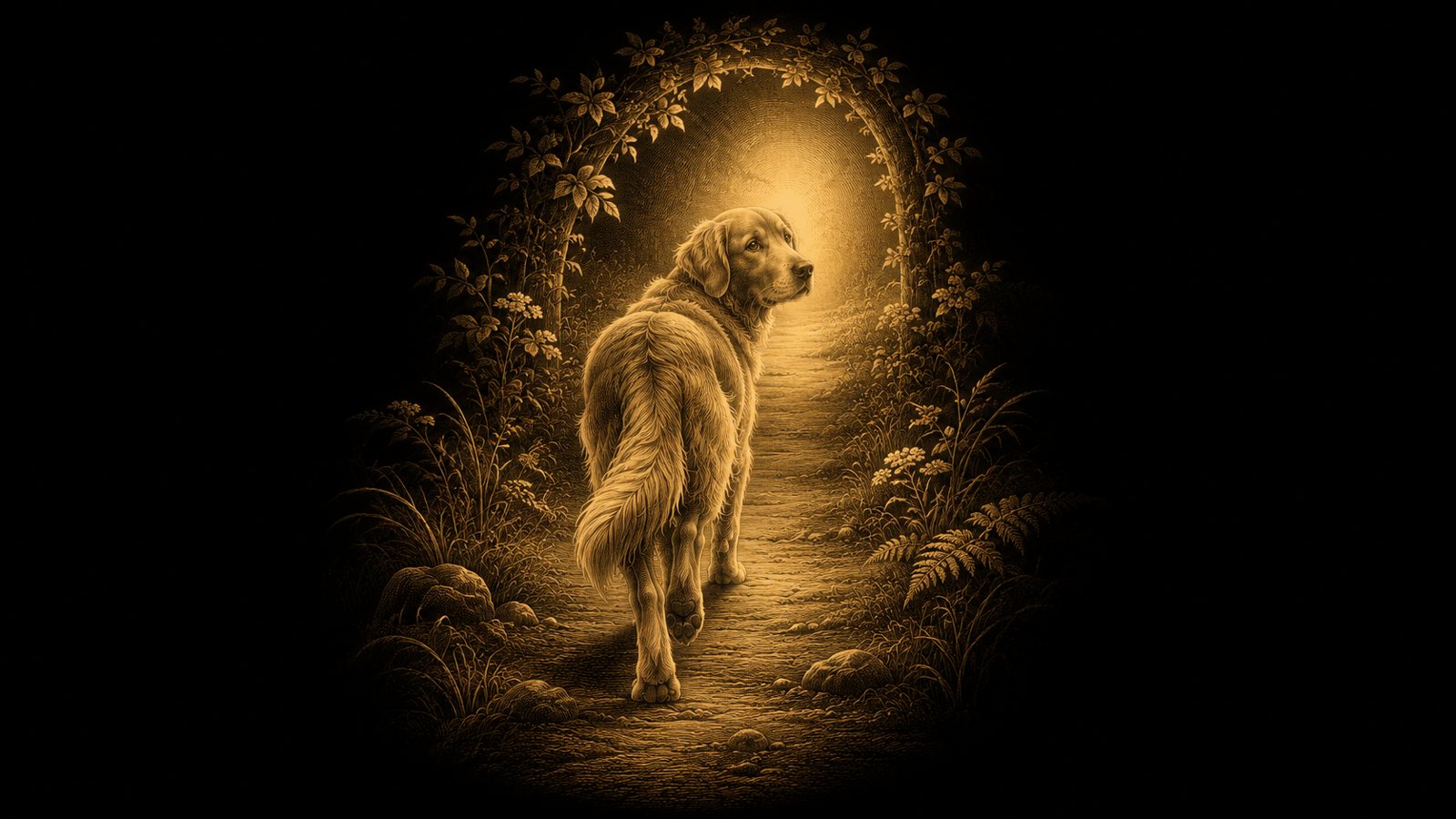
There is a moment that everyone who loves a dog quietly dreads: the last breath, the stillness that follows. And behind the grief, a question we rarely say aloud. What does our companion experience when it crosses from this world into the next?
Edgar Cayce, the American mystic known as the "sleeping prophet", is said to have spoken about this in his readings. What follows is a gentle retelling of what is taught in his name. It is a spiritual belief and not something anyone can prove, but many grieving people have found comfort in it, and I offer it in that spirit.
A gentle crossing
According to this teaching, death is not an abrupt end but a smooth transition, and for dogs it is even gentler than for people. Animals do not carry the weight of ego, the dread of death or the many beliefs we gather over a lifetime. They simply allow the process to unfold.
In the final instant, a dog's consciousness is not extinguished but expanded. Cayce is said to have described it as a soft awakening, like waking from deep sleep into a bright morning. The pain that may have marked the last days is gone. There is no tired heart, no stiff joints, only a sense of absolute lightness.
During life, a dog perceives through the senses of its body: sight, scent, hearing. At the moment of transition those filters fall away, and it perceives dimensions that were always there but invisible to the physical eyes. The picture offered is of someone turning on all the lights in a house that you had always lived in the dark.
And there is no fear. Fear, the teaching says, depends on attachment to the body and to the self, and dogs live so fully in the present that, when it is time, they go forward with trust.
Does it feel our grief?
Many of us ask whether our dog senses our pain in that moment. The answer given is yes. In the first seconds, the dog is still close to the physical world, "standing at the exit door", glancing back one last time. It perceives your tears, and its first impulse is to comfort you, which is what it always did.
This is why so many people feel a quiet peace right after a pet dies, a calm that makes little sense given the sorrow. In this telling, it is the dog's first conscious act after leaving the body: a wave of love that says, "I am okay. Do not suffer for me."
When your dog closes its eyes for the last time, it is not entering darkness. It is entering light. This is only the end of a chapter, not of the book.
Waking in a new place
What happens next depends, the teaching says, on how the dog lived and how it died. A dog that passes peacefully, surrounded by love, awakens with clarity and without panic, a little like waking in an unfamiliar room yet feeling you are where you belong. A dog that dies suddenly or with great suffering may feel a brief confusion, not as pain but as an adjustment of consciousness, like when a dark screen is suddenly turned to full brightness and the eyes need a moment. In the astral plane, time does not work as it does here, so this lasts minutes or hours in our terms.
The place where it awakens is said to reflect the animal's own nature, so it feels natural, nurturing and familiar. And the body works differently. The old dog who could barely walk can run again. The dog that lost its sight or hearing perceives everything clearly. Cayce is said to have spoken of a spontaneous euphoria in these first moments, as the animal rediscovers the fullness of its abilities. It can move simply by thinking of a place.
Who comes to meet them
The most moving part of the teaching is that no dog crosses alone. Three kinds of presences are said to receive it.
First, other animals who passed before it: the dogs and cats and other companions your family has known. Even one that left before this dog was born can be recognised at once, for souls are said to know each other beyond form and time. Second, evolved animal spirits, called guardians, who have chosen to guide others through the passage. They understand the confusion and the longing for one's person, and communicate peace without sounds: You are safe. We are here. Third, human souls who loved animals during their lives, perhaps a grandfather who adored dogs, or a relative you never met. They carry the familiar energy of family and home.
Your dog is not received by strangers but by a community that already loved it. And among them, the teaching says, there is always at least one whose task is to help the dog stay connected to you without becoming stuck between the worlds. This guardian helps it understand that it may feel you and send you love, and even visit, but that it has a journey ahead.
The presence you feel
Perhaps you have felt your dog near in the days after it died: a weight beside you on the couch, a touch on your leg at night, the jingle of a collar, a familiar sigh in the hallway. You may have wondered whether you were imagining it. Grief is real and does shape what we notice, so I will not say what is certain. In Cayce's teaching, though, the connection is not broken by the death of the body. In some ways it grows stronger, since in the spiritual plane thought and presence are the same.
During the first three to seven days, the dog is said to visit the places you shared. It walks the same paths and lies in the same corners, not because it is lost but because it is still processing the separation and wants to be near you. It perceives your emotions as waves of colour: your sadness as a heavy, dark wave, your love as a warm, bright light. It does not analyse or judge. It simply feels, and wishes to turn sadness into peace.
You can speak to it in these days, not with words so much as with feeling and intention. Close your eyes, picture it, say aloud or silently that you love it. Many people do this instinctively when they look at a photograph and whisper, "I hope you're okay, my love." The teaching says this is a real message, and that the answer might arrive as an unexpected sense of peace, a vivid dream or a quiet knowing.
Dreams, in particular, are seen as a meeting place. A dream of your dog soon after its death that feels strikingly real may not be only your mind sorting its loss. It may be an actual encounter. If it appears young, healthy and happy, running freely, that is said to be a message that it is well.
Releasing with love
The teaching also speaks of something delicate. Dogs who had a particularly close bond sometimes choose to stay near longer, as if saying, "I know there is a path ahead, but I won't go while you are suffering so much." Prolonged, inconsolable grief is said to act as a kind of anchor.
I want to be careful here, because no one should read this as blame. Grief is not a failing; it is love with nowhere to go. But if you find, over time, that you can let gratitude stand beside the pain, and celebrate the years you had instead of only mourning their end, the teaching says you are releasing your dog to move forward with lightness. You are saying: I love you. I will miss you. Go and grow. We will meet again. The bond is not weakened by this. It is purified, becoming subtler but no less strong.
Healing beyond the body
You might think that a dog free of its sick body and surrounded by love has nothing left to heal. The teaching answers that every being gathers impressions throughout life, some luminous, some dark: fear, abandonment, trauma. These marks remain in consciousness after the body is gone.
Think of a dog rescued from the streets after hunger and cold, or one that suffered through illness and difficult treatments. In the spiritual plane, it is said to be bathed in what Cayce called the creator's light, a vibration of pure love. The guardians and other animals help dissolve the knots, not through words but through presence and touch.
Imagine a dog that carried a quiet belief that it might be left behind, and perhaps trembled whenever you left the house. A guardian now conveys, without language, that it was never abandoned, only loved. The mark does not vanish as though it never existed, but it loses its power to hurt. It becomes only memory. Echoes of physical pain, such as the breathlessness of a final month, are said to soften until they disappear.
Even the limits of the canine mind are said to fall away. Consciousness widens, like someone who always looked through a tiny window suddenly standing in an open field. The guardians teach the dog to remain itself, with its own personality, while knowing it belongs to something larger. In time it understands, without words, that every moment with you mattered: each time it made you smile, each time it stayed by your side when you were sad. It was never just a dog living a dog's life. It was a soul on a journey of love.
How long do they stay near?
There is no fixed timeline. Every bond and every soul is different. Still, the teaching describes three phases. The first, an "immediate vigil", lasts about three to seven days, when the dog is closest and keeps returning to you. The second, from roughly two to six weeks, brings fewer signs, though a vivid dream or sudden presence may still come. The third is full integration into the spiritual plane, around six weeks to three months, when the dog has processed its life and healed. It no longer visits as often, but not because it forgot you. The bond itself has no expiry date.
Cayce is said to have ended with an image. Imagine the universe as a great circle, and you and your dog as two points on it. From where you stand it can look as though you are on opposite sides, but neither has ever left the centre, and the centre is love. When the circle completes, you will meet, as if you were never apart.
A last thought
If you are grieving, you do not need to decide whether all of this is true. You only need to know that your sorrow is a measure of your love, and that love is rarely wasted. Perhaps, in the quiet of an evening, you can say a few kind words to the one you miss, and sit for a while with the idea that every goodbye might be a "see you soon" in disguise.
Quantum Entanglement, the Subconscious and the Energy You Carry
A calm look at quantum entanglement as a metaphor for how thoughts, emotions and the subconscious may shape the life we experience.
Read →
How to Remember Your Soul Contract and Your Life's Mission
Signs, patterns, gifts and quiet practices that many spiritual traditions say can help you rediscover the purpose your soul chose before birth.
Read →
Edgar Cayce's Prophecy About Dogs and the Awakening of Our Companions
A reflective look at a prophecy attributed to Edgar Cayce about dogs as spiritual companions, and the stories people tell of their pets.
Read →